From Free Technology for Teachers: "Live Binder is a free online service that allows you to create online binders of webpages, images, and documents. Live Binders displays your collected content in a tabbed, book-like format. You can create binders for as many topics as you like. Adding content to your Live Binder can be done by manually typing in the url of a webpage, upload files from your computer to your Live Binder, or add content through the Live Binders browser add-ons for Firefox, Chrome, Safari, and Internet Explorer." This site is a great way to group resources for a class research project or for a department.
Example: Tools for World Languages
Showing posts with label Science. Show all posts
Showing posts with label Science. Show all posts
Monday, January 30, 2012

Frozen Planet
From Free Technology for Teachers: "Frozen Planet: Explore the Polar Regions features an interactive display through which you can view the history of polar exploration and the science of the polar regions. The interactive display is created through the use of the Google Earth browser plug-in and a timeline. You can click along the timeline to see and read placemarks on Google Earth. You can browse through and click on a list of important places in both polar regions. For further investigation and analysis of the polar regions you can activate a number of Google Earth layers within the Frozen Planet display. The display also includes videos about each region although the playlist for the Antarctic region is much longer than the playlist for the Arctic region."
(Computers do need the Google Earth plug-in)

(Computers do need the Google Earth plug-in)

Wikispaces
Wikispaces - Start a Wiki for your class or for a specific project. What is a wiki? A wiki is a website created by one person, but where many people can add content and collaborate. For example, a teacher can post a discussion question to their Wiki and students can log on in class or from home to add to the discussion. Students can create Wikis for group projects, students can create Wikis to do lab reports, history classes can create a Wiki around one historic event or time period, and more!


Jeopardy Lab
Jeopardy Lab: Create Jeopardy games online within minutes. This program is totally free and really easy to use.


Glogster
Glogster – Create online posters using images, videos, links, audio and more. A nice (less messy, more interactive) alternative to a traditional poster. See video tutorials at: Glogster Info.
Voki Avatars
Voki Avatars - A free service that allows your students to create personalized speaking avatars and embed them on a blog or wiki or send them via e-mail. This service provides numerous features to help students personalize their speaking avatar's voice, appearance, hair color, background, clothing, and more.
Example: George Washington Voki
Example: George Washington Voki

Rocks and Weathering
BBC's Rocks and Weathering - Rocks & Weathering is a great animated site produced by the BBC. The site using interactive animations to teach students all about rocks.



Biomes of the World
Biomes of the World - A great site that explores biomes with graphs, maps, images, and video. The site also features video podcasts and lesson plans.


What Are Continents?
- Continental Drift - A Flash Player video that shows the gradual continental drift.
- What Are Continents - A video that asks and tries to answer the questions, "What are continents?" and "How many continents are there?" The video proposes a handful of different ways to look at how we divide the world.
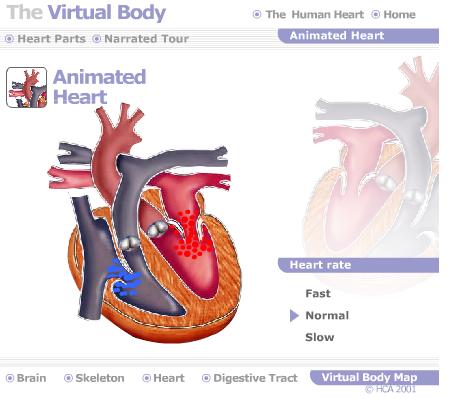
Virtual Body
Virtual Body - This site allows users to zoom in on each body system, play games with anatomy, take narrated tours of systems, and more.


Virtual Cell Animation
Virtual Cell Animation - The Molecular & Cell Biology department at North Dakota State University hosts a collection of virtual cell animations. The collection introduces students to seventeen molecular and cellular processes. For each process there is a series of annotated images, a text explanation, and a video explaining the process.


NASA: Moonbase Alpha
From Free Technology For Teachers: "Moonbase Alpha is an online game developed by NASA. Moonbase Alpha is a simulation game in which players assume the role of an astronaut working to repair equipment in order to restore oxygen delivery to a settlement on the moon. The game can be played by up to six players at a time who communicate using voice over communication."
Click on the video below to see the game in action:
Click on the video below to see the game in action:
Subscribe to:
Posts (Atom)